Search "South Asheville home prices" and you get one median. Pull the actual numbers for the neighborhoods hiding inside that search and you get at least three different housing markets wearing the same ZIP code. As of February 2026, the median home value across 28803, the ZIP code that covers most of South Asheville, sat at $445,565. In the same stretch of 2026, homes inside Biltmore Park, a single master-planned community a few miles down the same corridor, were trading for a median between $910,000 and $1.3 million depending on the month you checked. Both numbers describe "South Asheville." Neither one describes the whole thing.
That gap is the problem with treating South Asheville as a single market. It isn't. It's at least three markets sharing a ZIP code and the same real estate search filters, and the blended figure that gets quoted online averages them into a number that describes none of them well.
One ZIP code, three different housing stories
South Asheville stretches from the edges of Biltmore Village down through Skyland and into unincorporated Arden. The homes along that corridor were not built by the same developer, in the same decade, or for the same buyer.
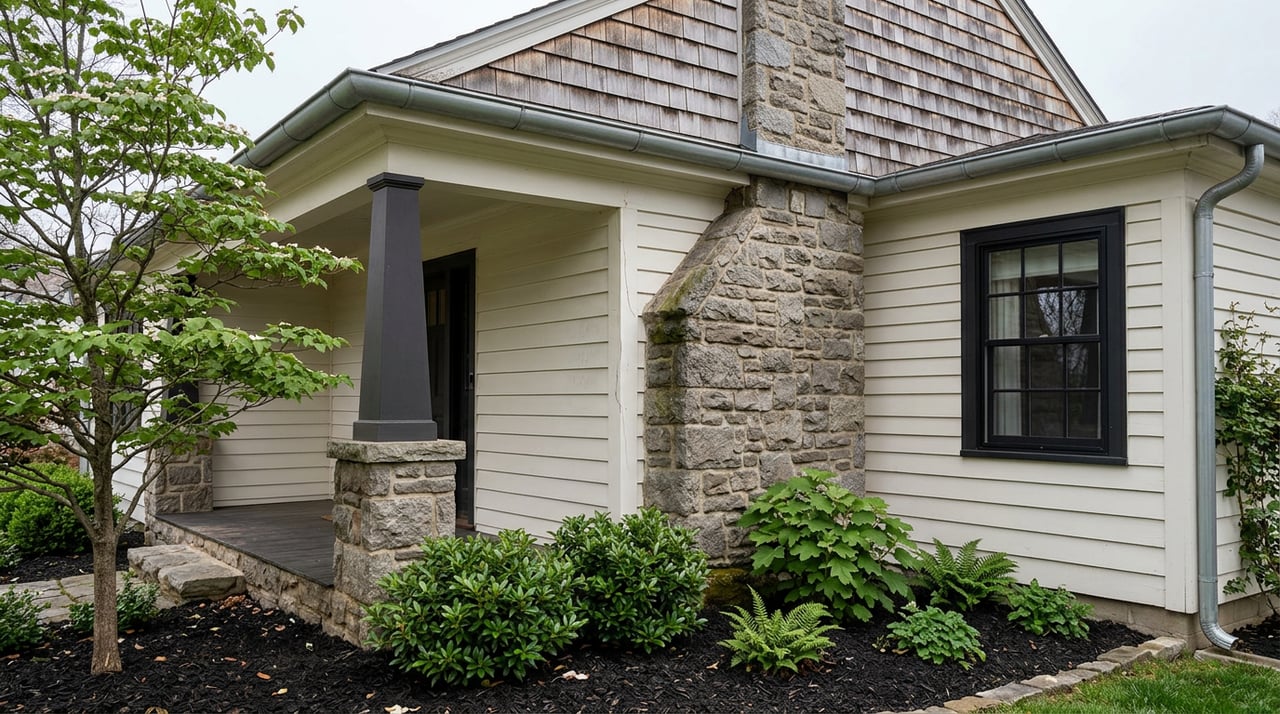
The oldest layer is neighborhoods like Royal Pines, with homes dating from the 1940s through the 1990s along Sweeten Creek Road and Hendersonville Road, close to longtime local spots like 12 Bones Smokehouse. These are ranch and traditional-style homes on established lots, and they anchor the affordable end of what "South Asheville" actually means.
The second layer is Biltmore Park, a 750-acre master-planned community developed by Biltmore Farms on land the Cecil family, descendants of the Vanderbilts who built the Biltmore Estate, had held for more than a century. Town Square is its commercial core: REI, Barnes & Noble, the Regal Biltmore Grande Stadium 15 movie theater, and a paved greenway that runs more than four miles through the community. It was designed as a walkable urban village, not a subdivision, and it prices accordingly.
The third layer is smaller and quieter: gated golf communities like The Cliffs at Walnut Cove in Arden, built on roughly 1,000 acres along the Blue Ridge Parkway with a course designed by Jack Nicklaus. So few homes trade there in a given year that public median-price data barely applies.
That $445,565 ZIP-wide figure from February 2026 sits below the $462,044 average home value Zillow was reporting for the city of Asheville as a whole as of late June 2026. It is also nowhere near what Biltmore Park was doing in the same window. The ZIP-wide number is real, but it's an average of neighborhoods that don't behave like each other at all.
| Tier | What defines it | Where it sits relative to the ZIP-wide median |
|---|---|---|
| Legacy subdivisions (Royal Pines, parts of Skyland) | Ranch and traditional homes dating from the 1940s through the 1990s | Anchors the lower half of the $445,565 figure recorded for 28803 in February 2026 |
| Biltmore Park | 750-acre master-planned urban village on former Biltmore Estate land | Median sale readings ran from roughly $910,000 to $1.3 million between February and July 2026, two to three times the ZIP median |
| The Cliffs at Walnut Cove | Gated, Nicklaus-designed golf community on nearly 1,000 acres | Too few annual sales for a meaningful public median, which is itself telling |
The number that should make you suspicious
Trailing three-month data through May 2026 showed Biltmore Park's median sale price up 62.4 percent year over year, reaching $1.3 million. That's the headline number that circulates. It also falls apart under a second look.
In that same window, the median price per square foot in Biltmore Park was $352, up only 3.2 percent year over year. If a typical Biltmore Park home had genuinely become 62 percent more valuable, price per square foot should have moved somewhere close to that. It moved a twentieth of it. The gap between those two numbers tells you what actually happened: bigger, pricier homes changed hands this year, not that the same style of home got dramatically more expensive.
Sample size explains the rest. Only 18 homes sold in Biltmore Park in May 2026, up from 6 in the same month a year earlier. A tripling of a very small sample, weighted toward a few estate-level closings, can swing a median by 60 percent without reflecting any real shift in what a repeat buyer would pay for a comparable house.
Two other readings from the same stretch of 2026 back this up. In February, the median list price in Biltmore Park was $1.27 million at $417 per square foot, with homes spending 116 days on market, unchanged from February 2025. If demand were genuinely accelerating, days on market should have compressed, not held flat. By July, a separate reading put the median home price at $910,000 with an average sale price of $953,413, nearly $400,000 below the May figure. Three snapshots, five months, three different medians. That volatility is the signature of a thin market, not a hot one.
The practical takeaway: a 62 percent year-over-year jump in a neighborhood this size is not proof that values are climbing. It's proof that the sample is small enough for a handful of transactions to move the whole number.
Meanwhile, the rest of the county is loosening
While Biltmore Park's headline number was spiking, the broader Buncombe County market was moving the other direction. In the first quarter of 2026, countywide home sales fell from 431 to 394 compared with the same quarter a year earlier, even as sales inside the city of Asheville rose slightly, from 242 to 255. Median prices edged down over that stretch too, with Buncombe County slipping from $450,000 to $446,000 and the city of Asheville from $506,000 to $493,000.
By the second quarter of 2026, the shift became clearer. Average days on market reached its highest second-quarter level since 2015 across both the city and the county. Inventory rose in nearly every price range compared with the previous four years. Median price per square foot declined in most price tiers, the clearest sign of a market that's turning more favorable to buyers than it has been in years. At the same time, the second quarter recorded more home sales than any quarter since the third quarter of 2024, the period just before Tropical Storm Helene, suggesting buyers stepped in as prices eased rather than staying on the sidelines.
Put those two stories side by side and the contradiction sharpens. The county-level data says buyers have more leverage than they've had in a decade. The Biltmore Park data, on its face, says the opposite. The honest read is that both are true in different corners of the same ZIP code: leverage has shifted toward buyers almost everywhere in South Asheville except the handful of transactions at the top of Biltmore Park's range, where thin inventory still lets a seller set the number.
The infrastructure variable relocators keep underweighting
South Asheville's Arden and Skyland pockets are routinely marketed around a single convenience claim: roughly ten minutes to Asheville Regional Airport. That claim is about to mean more than it did a year ago.
On August 7, 2026, the Federal Aviation Administration confirmed the opening of AVL's new 121-foot air traffic control tower, replacing a facility that dated to 1961. The $31.7 million tower is one piece of a terminal modernization program, AVL Forward, that broke ground in August 2023 and carries a price tag north of $400 million. A new south baggage claim opened in April 2026, a new rental car facility opened in May 2026, and the full terminal expansion is targeted for completion between late 2027 and early 2028. Air carrier operations at the airport have grown more than 300 percent over the past decade, making it the third-busiest airport in North Carolina.
None of that changes a home's price today. It does mean the convenience premium that Arden and Skyland listings lean on is backed by an active, multi-year federal investment rather than a static fact about drive time. Buyers weighing that tier against Biltmore Park's walkability or the legacy subdivisions' affordability should treat the airport build-out as a live variable through 2028, not a settled amenity.
What this means depending on your number
If your budget sits under roughly $450,000, the legacy subdivisions along Sweeten Creek and Hendersonville Road, places like Royal Pines and pockets of Skyland, are where the ZIP-wide median actually lives. That's the real South Asheville entry point, not Town Square.
If you're working with $700,000 to $1.3 million, Biltmore Park's walkable amenities come into play, but pull actual recent comps for the specific product type you want, townhome versus single-family, rather than anchoring to a headline median built on a handful of sales.
Above that, in communities like The Cliffs at Walnut Cove, you're in a market with too few annual transactions for public medians to mean much. Pricing conversations there run on individual comps, not ZIP data.
FAQ
Is South Asheville a buyer's or seller's market right now? It depends which South Asheville you mean. As of the second quarter of 2026, rising inventory and the highest second-quarter days-on-market since 2015 point toward buyers having more leverage across most of the area. The thin upper tier inside Biltmore Park and similar gated communities behaves differently, since a small number of high-value sales can still make those listings look competitive.
Why did Biltmore Park's median price jump 62 percent? Price per square foot in the same window rose only 3.2 percent, and the total number of sales was small, 18 homes in May 2026 versus 6 a year earlier. That combination points to a shift in which homes sold, larger and more expensive ones, rather than a broad increase in what a typical home there is worth.
Does the 28803 ZIP code cover all of South Asheville? Not entirely. The 28803 ZIP code runs south through the Skyland area before the unincorporated community of Arden begins on its own, which is part of why price data for that stretch can be harder to pin to a single, clean number.
South Asheville's median price is a real number. It just isn't a useful one on its own. If you're weighing a legacy ranch neighborhood against Biltmore Park's Town Square or a gated golf community in Arden, the comps that matter are the ones for your specific street and price band, not the ZIP-wide average. That's the kind of pulled, neighborhood-level data our team at Carter Sowers puts together for buyers and relocators every week. Request a Free Home Valuation and we'll show you what your number actually looks like against the right comparison set, not the blended one.