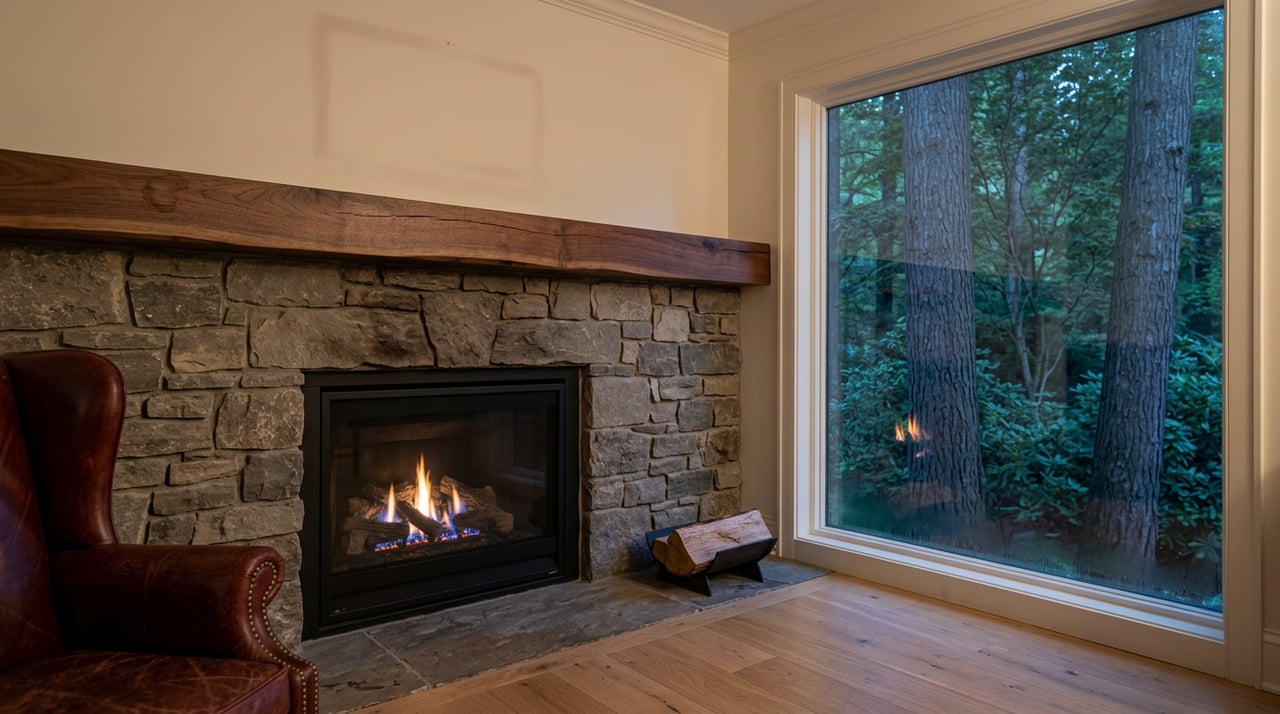
The black walnut tree had been standing on Biltmore Estate land for decades before Hurricane Helene took it down in September 2024. Most storm debris in Biltmore Forest got hauled off and chipped. This tree went to Sundried Lumber in Woodfin instead, where it spent six weeks in a solar kiln before master woodworker Kwadwo Som-Pimpong turned it into a mantel. On February 17, the Town of Biltmore Forest and the nonprofit Echoes of the Forest installed it above the fireplace at Town Hall on Vanderbilt Road, the same building that hosts the town's council meetings and holiday gatherings.
It's a small, deliberate gesture. And it's the same instinct driving almost everything on Biltmore Forest's calendar this summer, just at a different volume than the version playing out next door in Biltmore Village. Both places are working through the same question right now: what does a hundred-year-old tree canopy owe the people who live under it, now that Helene took a real chunk of it down. Biltmore Forest is answering that question quietly, park by park and speaker series by speaker series. Biltmore Village is answering it in public, with a $2.5 million grant and a genuine fight over whether to save the trees or save the sidewalks.
The canopy did not come back on its own
Asheville Greenworks estimates that Helene damaged or destroyed roughly 40% of the region's tree canopy, a scale of loss the organization's community forestry manager has said will take decades to fully recover from. Biltmore Forest, tucked against the Biltmore Estate boundary, didn't flood the way Biltmore Village and the River Arts District did. What it got instead was wind and volume: trees down across the town, hard enough that the storm opened up sections of the town's parks that had been overgrown and inaccessible for years.
The town used that opening. Federal American Rescue Plan funds that had already been earmarked for a stream restoration project at Greenwood Park got stretched further once the storm cleared brush the town hadn't planned to touch. A 35-foot bridge went in to replace a rotting structure, built solid enough that it didn't move an inch when Helene's floodwaters tested it just months after it was finished, according to town manager Jonathan Kanipe. At Brooklawn Park, the same debris cleanup gave the town room to cut its first trail and bring in a forest management crew to pull invasive species before replanting with natives, work the North Carolina League of Municipalities documented as part of the town's broader recovery story.
A speaker series instead of a spectacle
None of that made headlines outside Biltmore Forest, which tracks with how the town tends to operate. Its Tree Committee runs a recurring program called Reforest the Forest, bringing in outside experts to talk through what a Southern Appalachian forest actually needs after a disturbance like Helene. Dr. Dave Ellum, Professor of Ecological Forestry and Dean of Land Resources at Warren Wilson College, opened the series in February with a talk on post-disturbance regeneration. Phyllis Stiles took the July 21 slot. The town's Tree Committee met again on August 4, and the Friends of Biltmore Forest, the volunteer group that funds much of this work, met the day before that.
This is what a full week looks like right now if you live inside the town limits rather than just visiting it:
- Aug 3, Friends of Biltmore Forest meeting, Town Hall
- Aug 4, Tree Committee meeting, Town Hall Social Room
- Aug 8, Picnic in the Park, Rosebank Park, 4:30 to 6:30 p.m.
The picnic is part of a series the Friends of Biltmore Forest run through Rosebank Park each summer, the same park where the town's July 4th parade ends every year after Vanderbilt Road closes for the morning. Rosebank sits between Vanderbilt and Park Road, has a play set and open lawn, stays open dawn to dusk, and by town policy can't be reserved by anyone. It's first come, first blanket.
Two weekends ago, that same neighborhood turned into a race course. The Kiwanis Club of Asheville ran its fourth annual Biltmore Forest 5K/10K on July 25, an out-and-back route through the town's rolling hills starting and ending at Carolina Day School on Hendersonville Road, with early packet pickup the day before at Mountain Running Company. If you missed race day but still want the hills, the Biltmore Forest Running Club, led by Blair Holl, meets on a regular schedule open to any skill level.
The louder version, one neighborhood over
Compare that to what's happening right now in Biltmore Village, where the same underlying storm damage is producing a much more public reckoning. The City of Asheville is using a $2.5 million grant from the North Carolina Department of Commerce's Small Business Infrastructure Grant program to rebuild sidewalks that Helene's floodwater eroded and tree roots have been buckling for years. But fixing the sidewalks means deciding what happens to more than five dozen mature trees along streets originally laid out by Frederick Law Olmsted and Richard Morris Hunt, the same pair George Vanderbilt hired to design the whole district as housing for his estate workers.
City planners presented three options at a July 22 public meeting held, fittingly, at Standard Pizza. One preserves most of the existing trees as they are. A second removes and replaces close to half of them to restore Olmsted's original allée between Biltmore Plaza and the Cathedral of All Souls. A third goes further, replacing the majority of the trees to rebuild the historic allées on both Biltmore Plaza and Boston Way. David Hazzard, interim division manager for the city's Planning Department, told Blue Ridge Public Radio the city is trying to take a scientific approach, but that resident and business input will decide it. Neal Reed, who runs operations for New Morning Gallery in the Village and owns the Fine Arts Theatre downtown, put the tension more plainly, saying his concern is respecting how the district's history has actually evolved rather than restoring one architect's original vision by default.
The stakes are real. The Swannanoa River crested at more than 27 feet during Helene, and the flooding did more than knock down trees. It's part of why some of the surviving ones, planted more recently in species not suited to a dense urban block, are now tangled in root systems that are cracking the very sidewalks the grant is meant to fix.
Where the argument gets walked through every night
Here's what makes this more than a planning department debate for anyone who actually lives in Biltmore Forest. The town has almost no commercial addresses of its own. When residents want dinner, they walk or drive the short distance into the Village, onto the exact sidewalks under review. The Corner Kitchen, set inside a Victorian home more than 125 years old, has been a go-to for farm-to-table brunch and dinner for two decades. Gemelli serves house-made pastas in the same storefront it recently returned to. Red Stag Grill, inside the Grand Bohemian Hotel, leans into steak and game. Fig runs almost entirely on outdoor seating when the weather allows, which in a district about to lose or keep a lot of its shade canopy is not a small detail. The Guajiro food truck parks daily at Hi-Wire Brewery's Village location for Cuban comfort food, and Burial Beer's Forestry Camp pours from more than two dozen taps alongside a full kitchen and a curated wine list.
Every one of those places sits on, or a few steps from, the streets the city is currently deciding how to shade.
What this actually tells you about the neighborhood
Biltmore Forest handled its own post-Helene tree loss the way it handles most things: through committees, volunteer groups, and a mantel nobody outside the town limits will ever see in person. Biltmore Village is handling the identical problem, canopy loss meeting infrastructure repair, in full public view, because its outcome touches a historic design legacy and a business district that depends on foot traffic. Those two responses aren't a coincidence. They're what happens when a town built to be quiet sits directly against a district built to be visited.
If you're already living inside Biltmore Forest's town limits, the practical takeaway is simple: the Village sidewalk decision, whichever of the three options the city lands on, will change what your evening walk to dinner looks and feels like for the next several decades. It's worth showing up to the next public input session if you haven't already.
If you're the kind of person who reads a post like this because you're curious about what it's actually like to live somewhere before you make a decision about it, that's a different conversation, and one we have with people fairly often. Carter Sowers and the team at Elevate Asheville spend a lot of time in neighborhoods like this one, watching how they actually function day to day, not just what the listing photos show. If you'd like to talk through what a specific Asheville neighborhood is really like to live in, reach out and Get a Free Home Valuation as a starting point for that conversation.